Every January the design magazines drop their trend lists, and every February somebody in Florida discovers the finish they fell in love with is already cupping, hazing, or growing something. Design trends get written for Denver and Nashville. St. Petersburg is a different animal: 75 percent average humidity, salt air off Tampa Bay, a hurricane season that runs half the year, and flood elevation rules that can dictate an entire scope before anyone picks a tile.
I am Jesse Battle IV. I am a fourth-generation St. Petersburg native, I have held a Florida Certified General Contractor license since 2003, and I sell residential real estate here with the Kym Coyle Group at Charles Rutenberg Realty. That combination means I get to watch both ends of this: what people put in their houses, and what those choices are worth three years later when they sell.
So here is the 2026 trend report with the Florida filter applied. What is actually trending nationally, what survives in Pinellas County, and the local rules that decide whether any of it is even legal on your house.
Stone and countertops: quartzite takes the crown
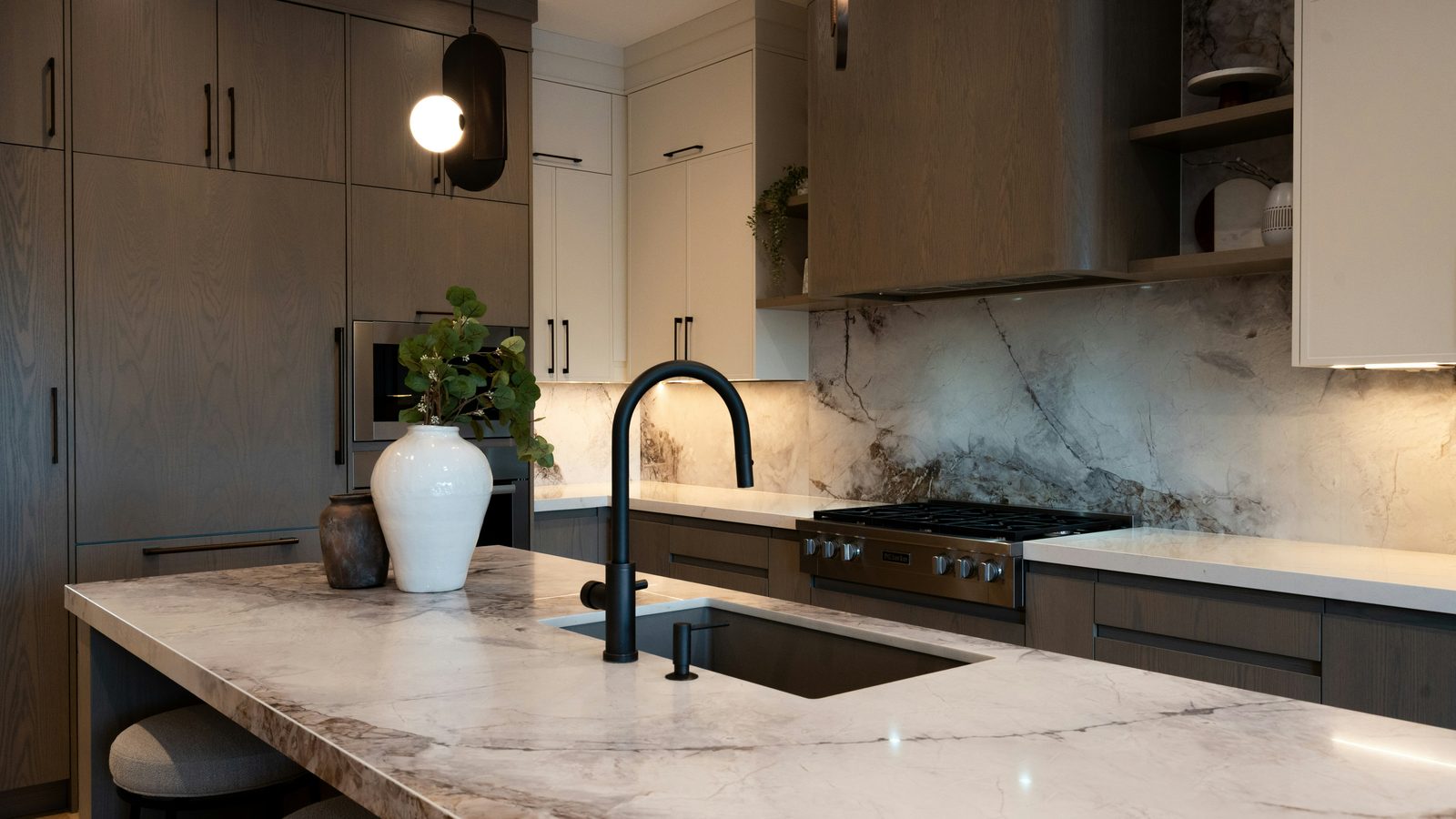
The biggest material shift of 2026 is the move away from quiet, uniform surfaces toward stone with real character. National Kitchen and Bath Association data puts natural quartzite at 62 percent for countertops and 61 percent for full-height backsplashes. Buyers are choosing slabs with expressive veining and visible movement instead of the safe neutrals that dominated the last decade. Waterfall edges, curved profiles, and sculptural edge details are part of the same move. The countertop is no longer a work surface that happens to be visible. It is the focal point.
What this means in Florida. Quartzite is a genuinely good call for this climate. It is harder than granite, dense, and handles heat well, which matters when a kitchen runs warm nine months a year. Marble is the trend everyone wants and the one that causes the most regret here, because it etches on contact with citrus, wine, and vinegar, and Florida entertaining involves all three.
Engineered quartz is the practical alternative and it is not a downgrade. The 2026 versions do veining convincingly. But keep it out of direct sun. Quartz uses polymer resin binders that can yellow and warp under sustained UV, which is a real risk in a St. Pete kitchen with a west-facing window or a lanai pass-through. If you are touring a house with quartz counters near a west window, look for a color shift along the sun line.
Large-format porcelain slab is the sleeper pick. UV stable, nonporous, immune to humidity, and it works indoors and out. For the indoor-outdoor kitchens that are standard here, porcelain runs the same surface through both without a transition problem.
Local reality check
Natural stone in a coastal home needs sealing on a real schedule, not whenever somebody remembers. Salt air accelerates everything. Budget for annual resealing on any porous stone and it will outlive you.
Cabinet colors: wood beat paint for the first time
This is the number that surprised the industry. Fifty-nine percent of designers now prefer natural wood over painted finishes, with white oak leading at 51 percent. Flat slab doors dominate at 69 percent of projects. The look is clean and modern, not rustic farmhouse.
For painted cabinetry, the palette warmed up dramatically:
- Warm neutrals are the volume play. Mushroom, taupe, greige, and clay have replaced cool gray and stark white.
- Deep greens are the strongest color trend. Forest, olive, and sage read as grounded rather than trendy.
- Moody darks work as anchors, not as the whole kitchen. Charcoal, soft black, and midnight blue on an island or pantry run, with lighter perimeter cabinets around them. Matte finishes keep dark tones from dating.
- Unexpected reds are the emerging wildcard. Burgundy, oxblood, and plum on bar areas and islands.
- Two-tone remains the low-risk entry point. Light uppers, deeper lowers or island.
Fading fast: cool gray cabinetry, ultra-gloss finishes, and the stark all-white kitchen paired with chrome.
What this means in Florida. The cabinet box matters more than the cabinet color, and nobody writes trend articles about that. In a humid coastal climate, particleboard boxes swell, delaminate, and fail. Plywood boxes with a moisture-resistant core are the single highest-value spec in the entire kitchen, and they are invisible in every listing photo ever taken. If you are evaluating a recently flipped house, open a cabinet and look at the raw edge of the box. It tells you more about the quality of the renovation than the countertop does.
On finishes: catalyzed conversion varnish and factory-applied finishes hold up far better here than site-painted latex. Site painting a kitchen through a Florida summer means fighting humidity during cure, and the finish never quite gets there.
On hardware: unlacquered brass is a major 2026 trend and it will patina fast within a few miles of the water. That is either the point or a problem, depending on the owner. Lacquered or PVD finishes hold their color.
Kitchen features for 2026
The functional trends are converging on one idea: hide everything, and make what stays visible worth looking at.
- Hidden storage over open shelving. Appliance garages, hidden pantry zones, and floor-to-ceiling cabinetry are replacing open shelves. In Florida this is also a dust and humidity win, since open shelves in a coastal home collect a film nobody enjoys.
- Handleless and integrated pulls. Push-to-open and integrated finger pulls create a continuous surface. Particularly effective in the smaller kitchens common in mid-century St. Pete bungalows.
- Mixed materials. Wood with metal, stone against engineered surfaces, texture layered on smooth.
- Strategic bold color. Applied to backsplashes at 60 percent and islands at 57 percent rather than the full room.
- Induction cooking. Gaining fast, and it makes particular sense here because it dumps far less waste heat into the room than gas. The AC load drops noticeably.
- Curved islands and softened geometry. The hard-edged rectangle is giving way to rounded corners and organic shapes.
Bathrooms: the wet room won
The 2026 bath is the most changed room in the house and the data is decisive. Houzz reports a 39 percent increase in shower size, with wet rooms now in 16 percent of renovated bathrooms, up three points year over year. NKBA found 55 percent of professionals say a larger shower matters more to homeowners than having a bathtub, and space allocation in the primary bath is a top priority for 89 percent of respondents.
Curbless is now the default request. Low-curb showers hit 52 percent of upgrades in the 2025 Houzz study and curbless reached 28 percent and climbing. It started as an accessibility feature and became an aesthetic one.
Grout lines are the enemy. NKBA found 89 percent of professionals want fewer or no grout lines on the floor, and 80 percent expect large-format tile to dominate over the next three years. The look is called stone-drenching: wrapping walls, and sometimes ceilings, in one continuous large-format surface.
Aging in place went mainstream and got pretty. Thirty-two percent of professionals say aging-in-place design is already mainstream and another 48 percent say it is getting there. Grab bars, shower benches, barrier-free entries, and wider doors are being specified as luxury features rather than medical ones. In a market with our demographics, that is a resale consideration, not just a comfort one.
Other bath features carrying 2026: floating vanities with layered lighting, wood-faced vanities at 62 percent, soft-close drawers at 78 percent and doors at 75 percent, built-in vanity outlets at 29 percent, recessed lighting in 40 percent of lighting upgrades, and soaking tubs at 62 percent of new tub installations with freestanding flat-bottom models at 45 percent.
What this means in Florida. The wet room is the trend that needs the most local scrutiny. A curbless shower requires recessing the subfloor and installing a linear drain, which is structural work. In a slab-on-grade St. Pete home that means cutting concrete. In an elevated or pier-and-beam home it means modifying joists. Neither is a weekend project and both need permits.
Waterproofing is where Florida bathrooms fail. In this humidity, a wet room built without a full bonded waterproofing membrane properly integrated at every transition will grow mold inside the wall assembly, and nobody finds out until the tile moves. Sheet or liquid-applied membrane systems and exhaust ventilation sized to actual room volume, rather than whatever builder-grade fan came in the box, are what separate a wet room that lasts from one that becomes a disclosure item.
The Pinellas County reality check nobody puts in trend articles
Here is the part that determines whether any of the above is even possible on a given house.
The FEMA 50 percent rule
If the cost of an improvement equals or exceeds 50 percent of the market value of the structure, not including the land, the project is classified as a substantial improvement. That triggers a requirement to bring the entire structure into compliance with current floodplain regulations, which usually means elevating the whole house above base flood elevation. A kitchen and primary bath remodel on an older, modestly valued St. Pete home can cross that threshold surprisingly easily.
Some Pinellas jurisdictions also track improvements cumulatively, meaning past permitted work can count against the total. Confirm structure value and improvement history with your local floodplain manager before committing to a scope. This is the single most common way St. Pete remodels get derailed, and it became dramatically more common after the 2024 storm season.
Flood zone and elevation. Much of Shore Acres, Snell Isle, Venetian Isles, and the beach communities sit in mapped flood zones. The elevation certificate drives everything from what can go on the ground floor to whether finishes need to be flood-damage-resistant materials.
Wind and impact requirements. Any window or door replacement in Pinellas has to meet current Florida Building Code wind-borne debris requirements. If a kitchen remodel includes a new window over the sink, that window has to be impact rated or protected.
Permitting timelines. Pinellas County and the City of St. Petersburg run separate review processes and neither is fast right now. Permitting belongs in the schedule from the start, not as a formality at the end.
What actually holds value in Pinellas
If you are weighing a remodel with resale in mind, or evaluating a house somebody else already remodeled, the local buyer pool cares about a specific list. It is not the same list as the national trend report.
- Documented permits. A beautiful unpermitted kitchen is a liability at closing. Every buyer agent in this market knows to check.
- Elevation and flood compliance. Post-2024, this is the first question serious buyers ask.
- Impact windows and doors. Direct insurance premium impact, which matters more here than granite ever will.
- Moisture-resistant construction. Plywood boxes, real waterproofing, adequate ventilation. Invisible, and it decides whether the remodel still looks good in year eight.
- Then the finishes. Quartzite, white oak, curbless showers. Great choices. Just not the foundation of the value.
That ordering is the whole point. The trend list tells you what looks current. The permit record, the elevation certificate, and what is behind the drywall tell you what the house is actually worth.
Trend data from the National Kitchen and Bath Association 2026 Kitchen and Bath Trends Reports and the Houzz U.S. Bathroom Trends Study. Florida code, flood, and permitting information here is general. Confirm requirements for a specific property with the City of St. Petersburg or Pinellas County building and floodplain departments.